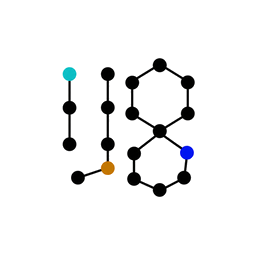
Imaginary machine, FORTRAN, plotter works.
Mission / legacy essay
The material is new; the stance is old.
ij8 begins from a simple argument: artists have always met new tools as materials. Ira Greenberg’s arc from painting to digital media, creative coding, and AI is one lived instance of that longer history.
00
Premise
Ira Greenberg is a creative technologist, artist, author, and educator working at the seam between human creativity and computation. His path — fine-art training, digital media, Processing-era authorship, academic program-building, on-chain generative-AI practice, and the current ij8 platform — is not a detour from art history. It is a version of a recurring artistic stance: meet the tool, learn its affordances and resistance, and make it a material for human expression. Today he directs the Center of Creative Computation at SMU, where computation is treated as a universal generative medium.
That stance matters now because AI arrives with unusual speed and unusual ambiguity. A brush leaves the hand visible. Code makes the instruction visible. A trained model can hide both the labor and the decision. The serious question is not whether artists may use AI; artists have always absorbed new apparatus. The question is whether direction, constraint, judgment, revision, and taste remain legible in the work.
Neither ban AI nor hand it the work. Teach people to direct and judge it, preserving authorship and productive friction.
01
The painter’s material
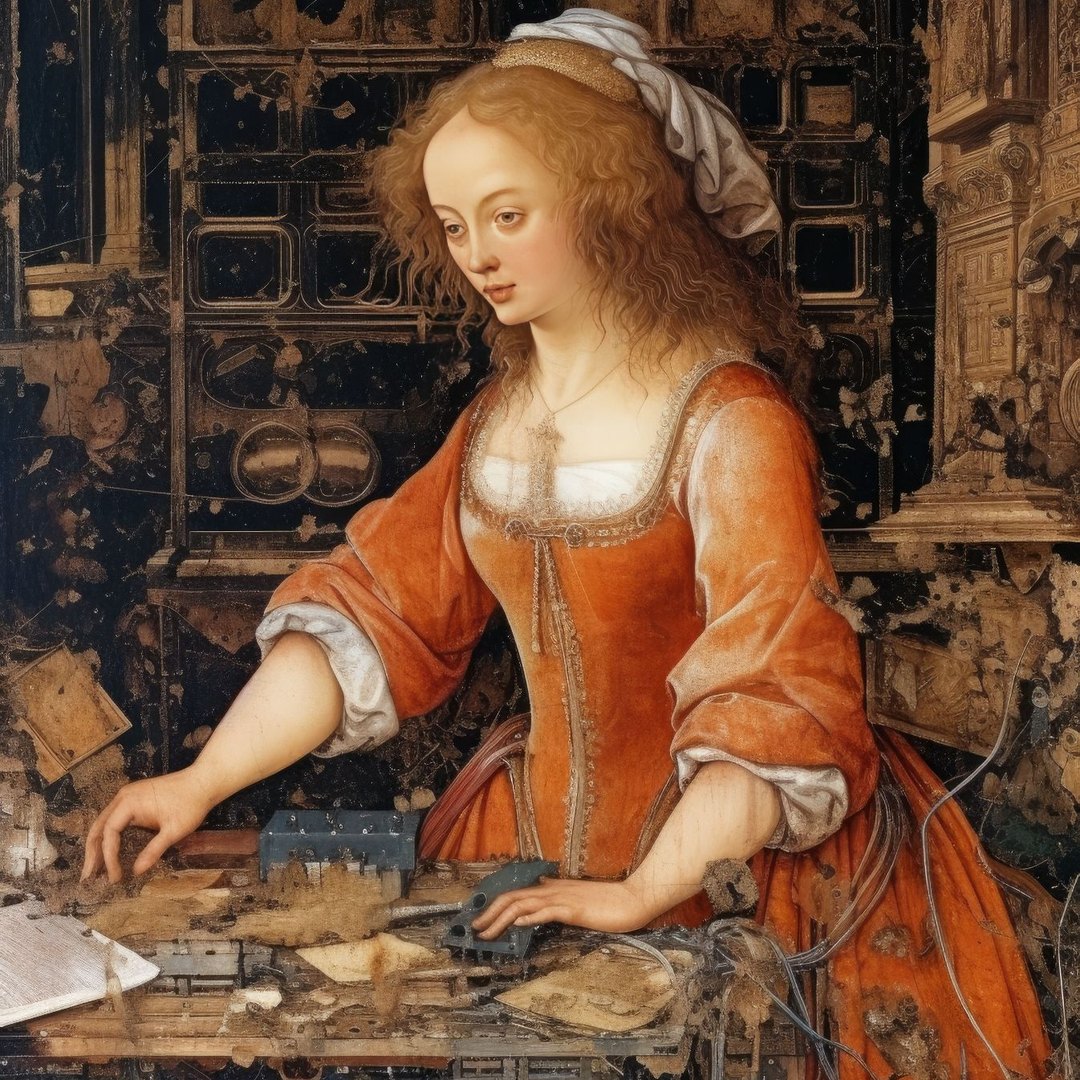
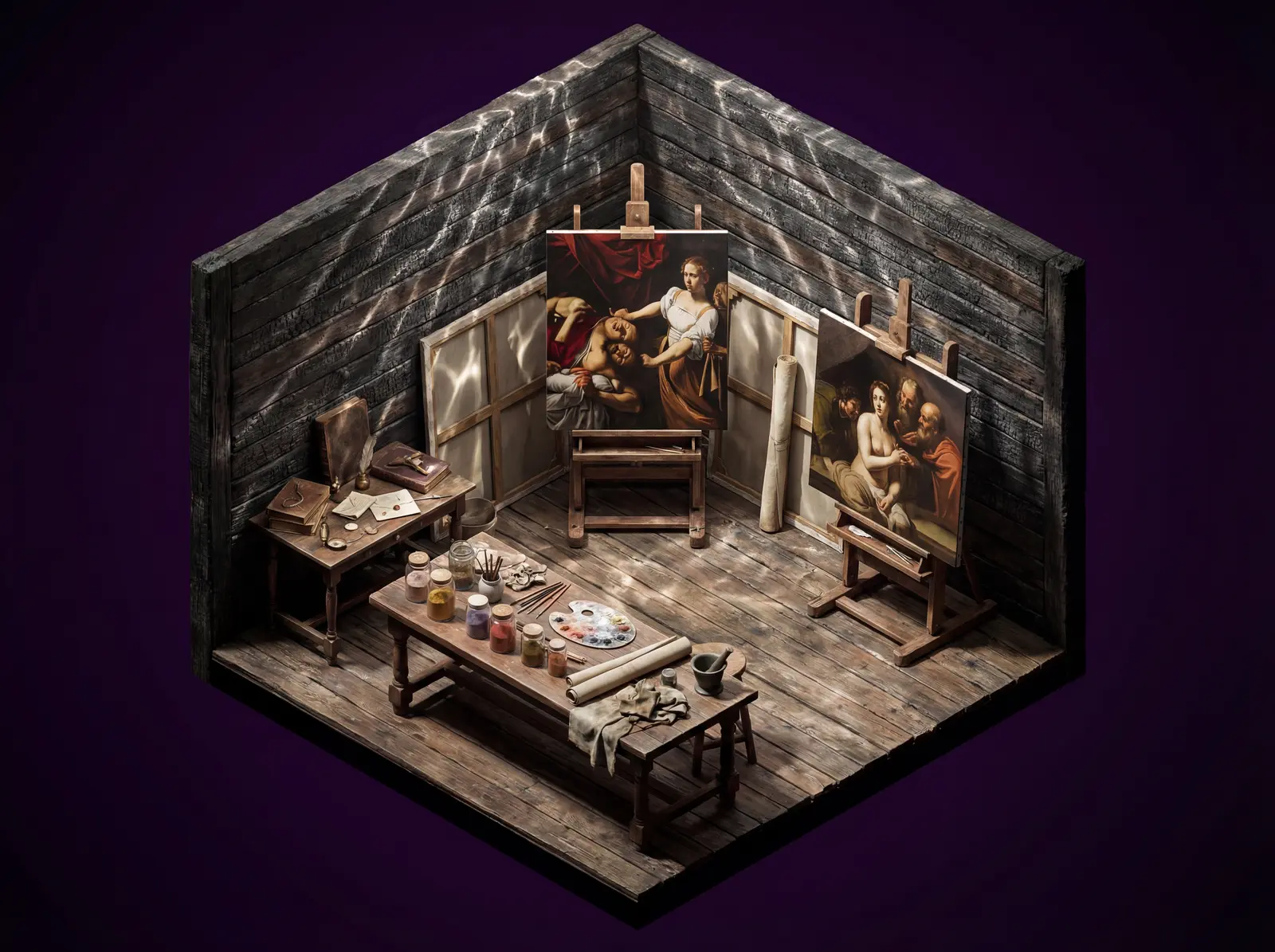
Before computation, Ira’s first medium was paint. His fine-art training was in painting: BFA Painting, Cornell University, 1989, and MFA Painting, University of Pennsylvania, 1992.
The point is not biography for its own sake. Painting gives the argument its first material premise: a medium has friction, pace, resistance, risk, and surface. It asks for judgment because it does not instantly obey. That early relation to material is the reason the middle-way position cannot be reduced to faster output. The work of the artist is partly the work of staying in contact with constraint.
Richard Sennett’s account of craft is useful here: craftsmanship names the human impulse to do a job well for its own sake, and it extends beyond traditional handwork to programmers and artists. In that sense, painting and programming are not opposites. They are different arenas for disciplined making.
02
The instruction becomes a machine
The idea that art can be made through instructions did not begin with AI. In 1967, Sol LeWitt wrote: “The idea becomes a machine that makes the art.”
That sentence gives the fine-art parallel for algorithmic work without pretending conceptual art and computation are identical. An instruction can become part of the artwork’s form. A system can stage execution. Authorship can include a rule, a sequence, or a procedure rather than only a hand-made mark.
The point is sharpened by the 1968 exhibition Cybernetic Serendipity, curated by Jasia Reichardt at the Institute of Contemporary Arts in London, whose theme Reichardt described as “the demonstration of machine-aided creative processes.” The machine was already entering the studio as process, not just as subject matter.
03
The algorists
Early computer artists did not use machines to escape authorship. They used them to invent new drawing conditions.
Vera Molnár used simple algorithmic procedures she called an “imaginary machine” before gaining computer access in 1968 and making plotter works. Frieder Nake began experiments with the Zuse Z64 Graphomat in 1963 and exhibited computer-generated works in 1965. Georg Nees programmed ALGOL drawings on a Zuse Graphomat Z64, his February 1965 Stuttgart exhibition is documented as the first public exhibition devoted to algorithmically generated computer graphics. Manfred Mohr programmed his first computer drawings in 1969 and showed computer-generated images at ARC, Musée d’Art moderne de la Ville de Paris, in 1971.
Zuse Z64 Graphomat experiments and 1965 exhibitions.
ALGOL drawings and early public computer-grafik.
Programmed aesthetics and early museum presentation.
Ben Laposky’s oscilloscope images and John Whitney Sr.’s analog-computer animations widen the frame. Electronic waves, analog mechanics, plotters, and programs all become visual materials with their own formal grain.
04
Computation becomes sketchable
The next shift was pedagogical: computation became something visual people could sketch with.
John Maeda’s Design by Numbers, published by MIT Press in 1999, introduced DBN as a programming language and environment for artists, designers, and others learning programming. MIT Press states that Maeda viewed the computer “not as a substitute for brush and paint but as an artistic medium in its own right.”
Processing grew out of Maeda’s Design By Numbers project and began in spring 2001 at the MIT Media Lab, created by Ben Fry and Casey Reas. Processing described itself as a software sketchbook for teaching programming fundamentals in a visual-arts context and for promoting software literacy in the visual arts and visual literacy in technology.
Ira’s Processing books belong in this pedagogical moment. His Processing: Creative Coding and Computational Art (Friends of ED, May 2007) became the first major comprehensive English-language reference devoted to Processing — the publisher describes it as “the first Processing book on the market,” and Processing.org’s books page lists only one earlier title, a brief Japanese-language introduction published that March.
The later verified titles are The Essential Guide to Processing for Flash Developers by Ira J. Greenberg, published in 2009, and Processing: Creative Coding and Generative Art in Processing 2 by Ira Greenberg, Dianna Xu, and Deepak Kumar, published in 2013. The through-line is teaching: making computation durable as a medium for artists, designers, and students.
05
Rules, noise, growth, evolution
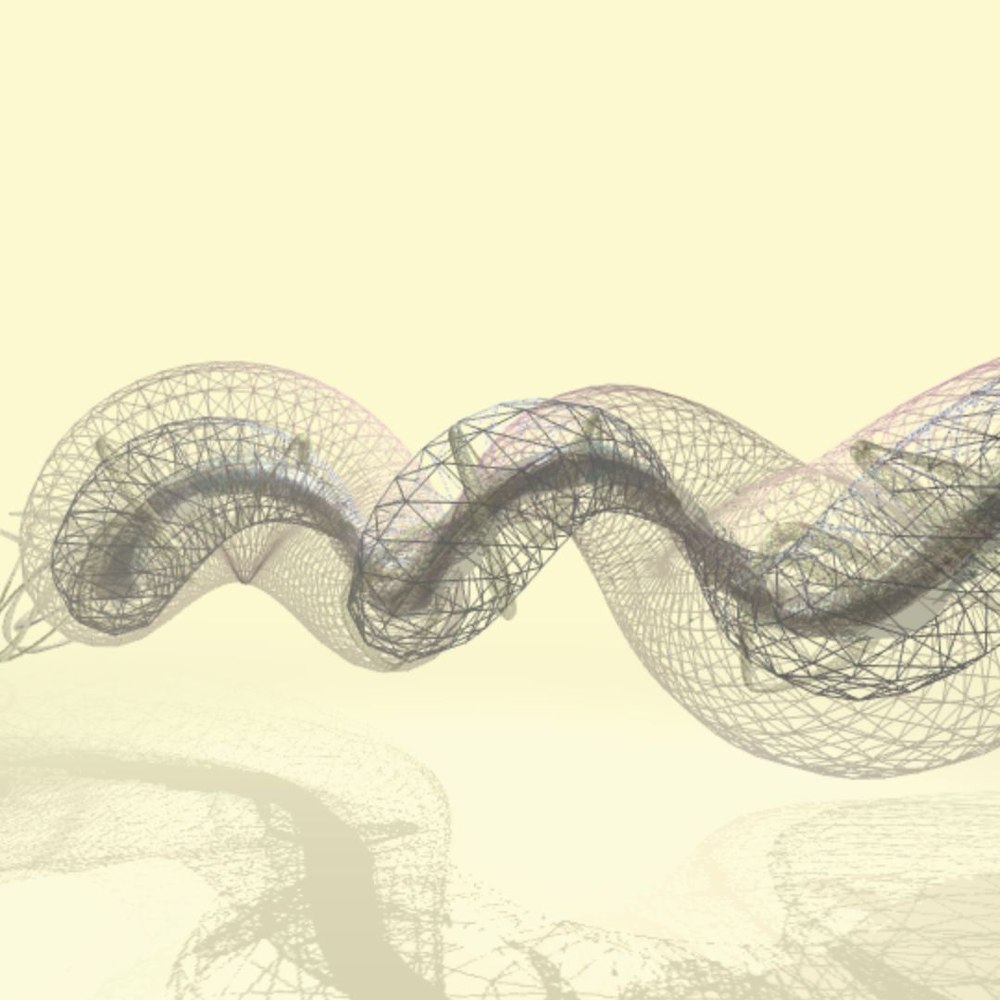
Generative art matures when artists stop treating code as a way to draw one form and start treating systems as materials.
Richard Dawkins’s 1986 biomorph software used selective breeding of computer-generated forms. At IBM UK in the late 1980s and early 1990s, William Latham and Stephen Todd developed an evolutionary computer-sculpture lineage — including FormGrow and Mutator — that let users breed and transform complex three-dimensional forms. Karl Sims’s 1991 SIGGRAPH paper Artificial Evolution for Computer Graphics described interactive evolutionary techniques for generating structures, textures, images, and animations; his 1994 SIGGRAPH paper Evolving Virtual Creatures used genetic algorithms to evolve morphologies and neural controllers for simulated creatures in 3D physics worlds.
Other procedural materials joined the vocabulary: Lindenmayer systems for plant development and computer-graphics plant modeling; Conway’s Game of Life and Wolfram’s cellular automata; Ken Perlin’s noise primitive; and Craig Reynolds’s boids, where flocking emerges from local behaviors of independent simulated actors. These are not metaphors. They are materials with parameter spaces, resistance, surprise, and behavior.
Dawkins, Latham/Todd, and Sims make variation and choice visible.
L-systems turn rewriting rules into botanical structure.
Cellular automata and boids show complexity from simple local rules.
Perlin noise becomes a procedural grain for images and motion.
06
The sketch leaves the desktop
Processing’s diaspora helped turn creative coding from a local artist/developer practice into web-native culture.
p5.js was created by Lauren Lee McCarthy in 2013 as a new interpretation of Processing for the web; the project credits Evelyn Eastmond as co-initiator. Processing.js was released by John Resig in 2008 as a JavaScript port of Processing using the HTML Canvas element. openFrameworks emerged in the mid-2000s as a C++ creative-coding toolkit associated with Zach Lieberman, Theodore Watson, and Arturo Castro, with its official history naming Processing and Ben Fry’s MIT Media Lab ACU Toolkit as precursors.
The hardware and browser lineages should be stated carefully. Hernando Barragán initiated Wiring in 2003 at the Interaction Design Institute Ivrea; Wiring built on Processing for artists and designers working with microcontrollers. Arduino’s own 2017 acknowledgment names Barragán’s Wiring as “the original foundation” that led to Arduino. Canvas, WebGL, and three.js form adjacent and overlapping creative-coding ecosystems, not a single descent line.
07
The model as material
AI art does not begin with diffusion models, or with GANs. AARON makes the continuity visible.
The Whitney describes Harold Cohen’s AARON as the earliest AI artmaking program, conceived in the late 1960s and named in the early 1970s. Cohen described AARON as a knowledge-based program representing image-making knowledge in rule form and modeling aspects of human art-making behavior. AARON is important because it makes AI art look less like a sudden rupture and more like a decades-long human-machine inquiry into drawing, rules, and authorship.
The neural era changes the material. Neural style transfer entered the AI-art canon through Gatys, Ecker, and Bethge’s 2015 paper. Google’s DeepDream appeared publicly in 2015. GANs were introduced by Goodfellow and collaborators in 2014; GAN-based art gained public visibility through works and sales by Obvious, Mario Klingemann, and Anna Ridler, while artists such as Refik Anadol widened the frame with data-driven machine-learning installation practice. CLIP-guided generation bridged GAN-era AI art and diffusion-era text-to-image culture; Stable Diffusion and DALL·E 2 made diffusion and natural-language image generation broadly visible in 2022.
The model era also acquired a native distribution form. On-chain generative art applied the publishing mechanism popularized by Art Blocks — an algorithm runs at mint, and each collector receives a unique output — and long-form generative AI extended that mechanism from hand-written rule systems to trained models. Provenance and edition become part of the material, fixed at the moment of generation.
Ira’s practice sits inside this chapter rather than beside it. He co-founded Emergent Properties, a platform devoted to long-form generative-AI art — described by SMU as “the world’s first Generative+AI art platform” — whose genesis project was his collection The Oracles (December 2022; one thousand editions on Tezos), among the earliest collections to apply mint-time generation to AI models, in what Outland that year called a new field. The work that followed traces the field’s young institutions: BEASTS with EXPANDED.ART in Berlin; Mappings on BrainDrops; Ancient Automata, an Art Blocks Engine project presented by Bright Moments in Venice, California; Materia Moda at Bright Moments’ London Dreamforum — all 2023.
08
The authorship problem
The middle way is only credible if it states the strongest objection fairly: AI can blur, hide, or collapse authorship.
The U.S. Copyright Office says copyright requires human authorship; in applications for registration, AI-generated material that is more than de minimis must be disclosed and excluded from the claim, while human-authored selection, arrangement, or modification may still qualify. Its 2025 Copyrightability Report concludes that generative-AI outputs may be protected only where a human author determines sufficient expressive elements, such as perceptible human-authored input or creative arrangement or modification; mere prompting is not enough. In Zarya of the Dawn, the Office protected Kris Kashtanova’s text and selection, coordination, and arrangement, but excluded individual Midjourney-generated images. In Thaler v. Perlmutter, the D.C. Circuit affirmed the Copyright Office’s refusal to register an image attributed solely to an autonomous AI system (March 2025), and the U.S. Supreme Court declined review in March 2026, leaving the human-authorship ruling in place.
There is also a philosophical version of the concern. Aaron Hertzmann argues that AI systems are tools rather than artists because art is a social act, and that crediting software as artist can obscure the humans who make the work possible. On the other side, McCormack and collaborators argue that generative systems that learn, adapt, and produce results not anticipated by programmers complicate simple tool authorship; d’Inverno and McCormack distinguish “Heroic AI” from “Collaborative AI,” where systems provoke, challenge, and support human art practice.
The tension is the point. AI does not automatically erase authorship, and it does not automatically preserve it. It becomes a usable artistic material only when the human work of direction and judgment is explicit.
09
Agency extended, not erased
The strongest defense of AI as material is not novelty. It is augmentation.
J. C. R. Licklider’s 1960 “Man-Computer Symbiosis” described close cooperative interaction between humans and electronic computers. Douglas Engelbart’s 1962 report defined augmenting human intellect as increasing a person’s capability to approach complex problems, gain comprehension, and derive solutions. Ivan Sutherland’s Sketchpad made it possible, in the ACM abstract’s words, for “a man and a computer to converse rapidly through the medium of line drawings.” Marshall McLuhan framed media as technological extensions of the body and emphasized the change of scale, pace, or pattern a medium introduces into human affairs.
Those anchors point to a position older than the current AI cycle: powerful tools matter most when they extend human capability while preserving human judgment. Maeda’s computer-as-medium, Processing’s software sketchbook, Sennett’s craft, and Ira’s own painter-to-AI arc all converge on the same demand. The human brings the vision, the taste, and the questions; the AI brings the speed and the hands.
10
ij8 as current chapter
ij8 is the present-tense synthesis: an AI art, creative-coding, and classroom environment where image, code, video, 3D, sound, storyboards, tutorials, and gallery distribution are treated as connected creative media.
The tooling reference documents the studio surface: chat-driven image, drawing, video, 3D, code, sound, storyboards, backend routing, gallery distribution, and hybrid workflows. The classroom reference documents the teaching surface: course authoring, lessons, tutorials, scoring, reports, App Lab, and student showcase. Together they make the same argument operational rather than rhetorical. The distribution layer is native rather than bolted on: ij8 ships its own gallery and Ethereum contracts, including generative drops in which reservation, generation, and on-chain fulfillment run as a single pipeline — the long-form publishing mechanism carried into the studio’s own infrastructure.
This is not “AI replaces the artist.” It is infrastructure for directing, judging, revising, teaching, and publishing with AI. The sibling references are the practical side of this essay: tooling.ij8.ai and classroom.ij8.ai. For working with Ira directly, see ira.ij8.ai; for institutional pilots, grants, and partnerships, pilots.ij8.ai.
11
Sources / colophon
This is a cited essay for vision.ij8.ai. Each entry below names the specific source behind the section’s dated, quoted, and priority claims, so any date, quotation, or “first” on this page can be traced to its evidence.
00–01 / Ira and craft
SMU faculty profile: roles, B.F.A. Cornell, M.F.A. Penn · SMU, Center of Creative Computation · Sennett, The Craftsman (Yale) · degree years from the artist’s own record.
02–03 / Instruction and early computer art
LeWitt, “Paragraphs on Conceptual Art,” Artforum (1967) · Reichardt on Cybernetic Serendipity (ICA 1968) · Mudam: Molnár · ZKM: Nake · compArt: Nees exhibition record, Feb 1965 · DAM: Nees · Mohr biography (ARC Paris 1971) · V&A: Laposky Oscillon · ACM SIGGRAPH: John Whitney Sr.
04 / DBN and Processing
MIT Press, Design by Numbers (1999), incl. the medium-in-its-own-right line · MIT Media Lab DBN archive · Processing.org overview (spring 2001, software sketchbook) · Processing.org books page (incl. the March 2007 Japanese-language title) · Springer/Apress, Processing: Creative Coding and Computational Art (2007), “first Processing book on the market” · Springer/Apress, Essential Guide to Processing for Flash Developers (2009) · Springer/Apress, Creative Coding and Generative Art in Processing 2 (2013)
05–06 / Generative systems and web diaspora
Dawkins, The Blind Watchmaker (1986) · Todd & Latham (Leonardo/Goldsmiths) · Sims, “Artificial Evolution for Computer Graphics,” SIGGRAPH 1991 · Sims, “Evolving Virtual Creatures,” SIGGRAPH 1994 · Prusinkiewicz & Lindenmayer, The Algorithmic Beauty of Plants · Gardner on Conway’s Life, Scientific American (Oct 1970) · Perlin: 1985 paper, 1997 Academy Award · Reynolds, “Flocks, Herds and Schools,” SIGGRAPH 1987 · p5.js People (McCarthy, creator; Eastmond, co-initiator 2013) · Resig, Processing.js (2008) · openFrameworks history · Wiring (Barragán, 2003, IDII) · Arduino statement on Wiring as “the original foundation” (2017)
07 / Provenance and platforms
SMU Meadows news (Feb 2023): EmProps co-founding, “world’s first Generative+AI art platform,” The Oracles as genesis project · Emergent Properties marketplace: The Oracles, Dec 13 2022, 1,000 editions, Tezos · Kaloh interview with the EmProps team (2023) · Outland: Greenberg & Tau on long-form generative AI · EXPANDED.ART, BEASTS (Berlin, 2023) · Meier, “Cracking the Code” (2023) · Art Blocks: Ancient Automata (Bright Moments, Venice CA, 2023) · Bright Moments: Materia Moda (London, 2023) · BrainDrops/OpenSea: Mappings (2023)
07–09 / AI and authorship
Whitney, Harold Cohen: AARON · Gatys, Ecker & Bethge (2015) · Google, Inceptionism/DeepDream (2015) · Goodfellow et al., GANs (2014) · Christie’s, Edmond de Belamy (2018) · Sotheby’s: Klingemann · Ridler, Mosaic Virus · MoMA, Refik Anadol: Unsupervised · Stable Diffusion (2022) · OpenAI, DALL·E 2 (2022) · U.S. Copyright Office, registration guidance (2023) · Copyright Office, Copyrightability report (2025) · Zarya of the Dawn (2023) · Thaler v. Perlmutter, 130 F.4th 1039 (D.C. Cir., decided Mar 18 2025) · SCOTUSblog docket: cert denied Mar 2 2026 · Hertzmann, “Can Computers Create Art?” · McCormack et al. (2019) · d’Inverno & McCormack, Heroic vs. Collaborative AI · Licklider (1960) · Engelbart (1962) · Sutherland, Sketchpad (1963) · McLuhan estate
10 / ij8
Sibling references: tooling.ij8.ai and classroom.ij8.ai — dated, periodically re-rendered catalogues of the studio and teaching surfaces; capability claims on this page defer to those documents.
Biographical facts are constrained to verified public sources; the full claim register, including what was deliberately omitted, is maintained internally. Self-hosted Inter. Local images. No tracking. No external scripts. Single-page static output for vision.ij8.ai. Last rendered .